 DigiDummysAdmin
Did you know the eLearning market might hit $400 billion by 2026? This huge growth shows a big change in how education is given, mostly because of digital changes. The pandemic made this growth faster. It pushed us into a new era of online learning. Now, technology in education is key for better grades. Dan Schwartz from Stanford Graduate School of Education says, this technology rush is great for reaching more students. But, it also brings challenges. These need solving to make sure we don’t keep using bad teaching methods.
Artificial intelligence (AI) tools like ChatGPT are changing education a lot since late 2022. I’ve seen AI chatbots help teachers by doing routine work. This lets teachers spend more time with students. Also, Augmented Reality (AR) and Virtual Reality (VR) bring learning to life. They make lessons interactive and fun. Looking at these trends, we see education’s future is about new ways of teaching. And, about how we mix these new tools into our lessons well.
Key Takeaways
- The global eLearning market is expected to reach $400 billion by 2026, highlighting significant growth in online education.
- AI tools, such as ChatGPT, have begun reshaping educational methodologies significantly.
- Gamification elements foster increased student engagement and motivation in learning environments.
- Immersive technologies like AR and VR provide enhanced interactive learning experiences.
- Data analytics through Learning Management Systems (LMS) are revolutionizing how educators assess student learning behavior.
- Blended learning environments combine traditional methods with digital tools to effectively cater to diverse learning styles.
The Rise of AI in Education
Artificial intelligence is changing education for teachers and students alike. AI tools are improving learning and teaching in many ways. UNESCO says this technology could reach a $20 billion value by 2027, showing its big potential.
Transformative Effects on Teaching
AI is pushing teaching towards adaptive learning which meets each student’s needs. Since the 1990s, intelligent tutoring systems have tried to mimic teachers with personalized lessons. These technologies help teachers by doing tasks like grading and spotting students who need more help.
Teachers can also make lesson plans that include everyone, thanks to better learning analytics. This creates a classroom where everyone is involved and learning is fun.
Benefits for Student Engagement
AI makes learning better for students by giving everyone their own learning path. Chatbots are there to help any time, making it easier to understand lessons. This always-available help cuts down confusion and keeps students on track.
By using learning analytics, teachers can change how they teach to keep students interested. Watching these advancements, I see that AI does more than help understand topics. It greatly improves students’ grades and success in school.
eLearning: Shaping the Future of Education
eLearning has changed how we learn, making education more engaging and effective. It brings personalized learning to the forefront. This approach considers each student’s unique needs. It allows their strengths to stand out. Adaptive technologies help teachers create lessons that fit everyone’s learning speed and style. This ensures students fully grasp important ideas.
Personalized Learning Experiences
More teachers are seeing the benefits of AI-driven personalized learning. More than half believe it boosts student engagement and helps them remember information better. With learning management systems, teachers can use adaptive strategies. These strategies help students become more independent and responsible. Online classes are great for students who need to fit learning around their jobs. They can study whenever it suits them.
The Broadening Scope of Access
Online education has made learning resources more accessible, making education fairer. Now, even people from underserved communities can get to educational materials that were once hard to reach. This step towards including more people is clear in the diverse learning settings we see today. Technologies like mobile learning help students from all backgrounds participate more. Providing top-quality education for everyone doesn’t just improve learning. It also builds a community feeling and social learning. These efforts help make sure no student falls behind. They are important for creating a fairer future in education.
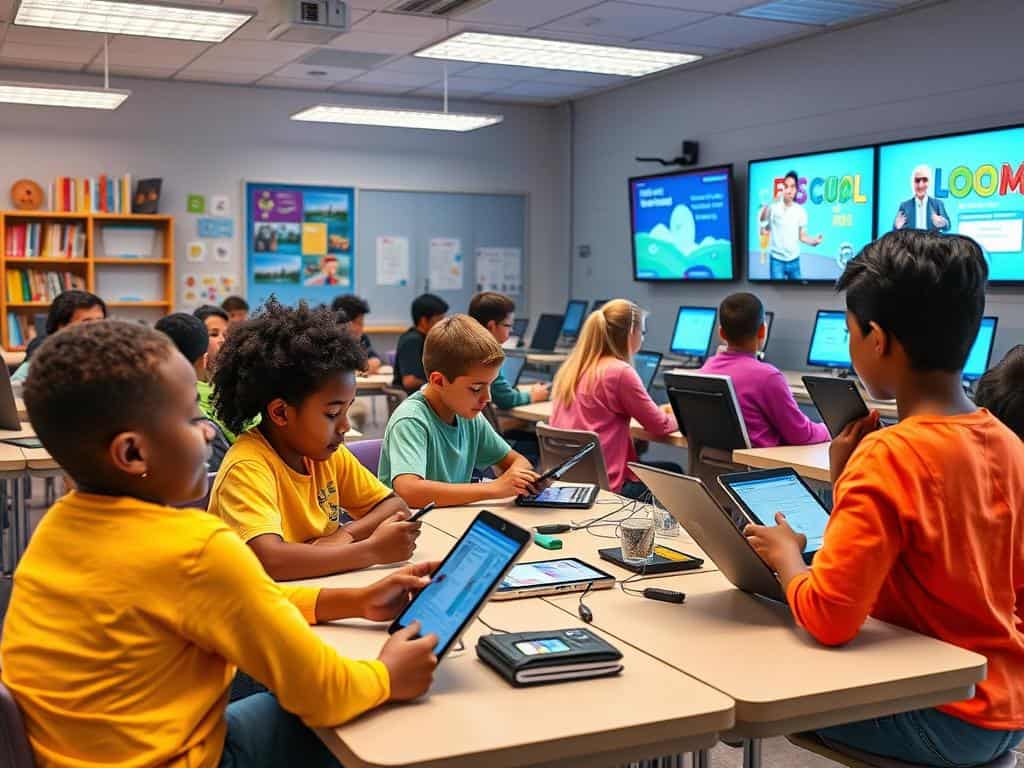
Immersive Technologies in the Classroom
Integrating augmented reality (AR) and virtual reality (VR) is changing education. These tools let students dive deep into topics. They learn in exciting ways, moving past old teaching methods. With interactive engagement, learning becomes more fun and effective.
Augmented Reality and Virtual Reality
Augmented reality blends digital info with the real world. This makes learning vibrant and interactive. Then, there’s virtual reality. It creates a whole new world for students. They feel more connected and involved.
Using VR, students can learn four times faster than usual. This means they focus better and feel more sure when using new skills. This is a big step forward in technology-enhanced education.
Enhancing Learning Through Simulation
Learning through simulation is very effective. It lets students test and practice in real-world like situations. They get to try things out in a safe environment. This boosts learner engagement.
This way, students learn communication and technical skills. It suits different learning goals. Plus, it makes students an active part of their learning. This is key in making learning by doing a real thing in schools.
Conclusion
The world of learning is changing fast, thanks to digital tech. We see that tools like AI and virtual reality are making learning more personal. They help keep students interested. Also, using multimedia helps students remember what they learn better. It’s key that teachers start using these new methods.
For teachers and students alike, these changes are exciting. Using data helps make learning fit each student’s needs better. It also helps them learn at their own speed. This supports the idea of learning throughout life. Also, people using mobile devices finish their courses quicker. This shows that digital tools are making education more efficient.
Looking at how things are going, it’s clear people want education that’s easy to get and good quality. Online platforms and tools for working together are making learning better. They make sure students everywhere can learn the same way. It’s an amazing time to be involved in education. I can’t wait to see what new changes will come.

